
Refurbished vs New Laptops: Which Fits?
A laptop refresh usually starts with a budget spreadsheet and ends with a harder question: do you pay more for a factory-fresh device, or buy a machine that has already had one working life and has been restored properly? In the refurbished vs new laptops debate, the right answer depends less on hype and more on use case, risk tolerance and how disciplined the refurbishment process is.
For UK buyers, that matters more than ever. Businesses are managing tighter IT budgets, schools need dependable devices at scale, and individuals want solid performance without paying premium pricing for features they may never use. The gap between refurbished and new is not just about age. It is about value, support, condition, expected lifespan and whether the device has been handled through a controlled process.
Refurbished vs new laptops: the real difference
A new laptop is straightforward. It comes direct from the manufacturer or authorised channel, unused, boxed, and covered by a standard warranty. You are paying for first ownership, current-generation hardware and the lowest possible chance of cosmetic wear.
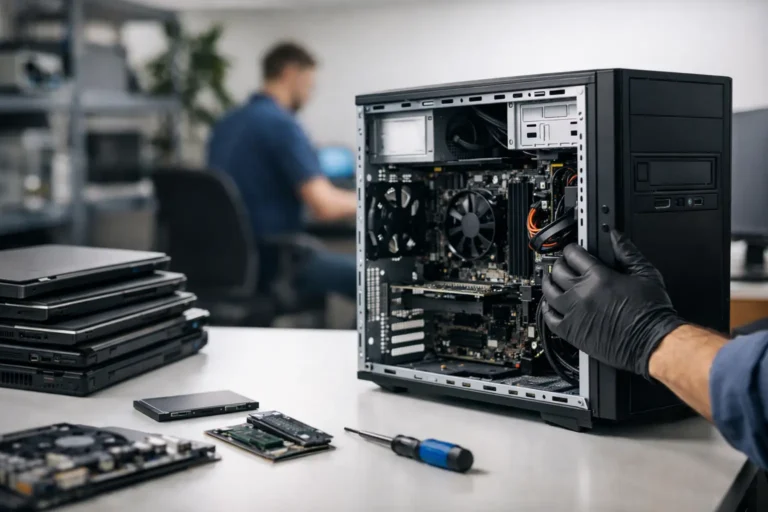
A refurbished laptop is not simply a used laptop. That distinction matters. A properly refurbished unit has been tested, cleaned, repaired where needed, and checked for functional faults before resale or redeployment. In stronger refurbishment models, storage is securely wiped, batteries are assessed, faulty parts are replaced, and grading is made clear before the device reaches the next user.
That means the real comparison is not new versus second-hand. It is new versus professionally restored.
Cost is the obvious factor, but not the only one
Price is usually the first reason buyers look at refurbished stock. A refurbished business laptop can cost significantly less than a new equivalent while still delivering the same core performance for email, office applications, browser-based work, video calls and light creative tasks.
For organisations buying in volume, those savings compound quickly. A fleet purchase of refurbished devices can free budget for docking stations, spares, software licensing or support. For individuals, the same logic applies on a smaller scale. The difference between an entry-level new laptop and a higher-spec refurbished model can be the difference between just getting by and actually working comfortably.
But cost alone can mislead. A very cheap refurbished laptop with weak battery health, poor-quality replacement parts or inconsistent testing can become expensive once downtime, repairs or early replacement are factored in. Equally, an expensive new laptop can be poor value if the workload only needs reliable mid-range performance.
The better question is cost over useful life. If a refurbished laptop gives three to four strong years at a much lower upfront price, it may be the more efficient purchase.
Performance depends on the workload
This is where buying new still makes sense in plenty of cases. If you need the latest processor generation, dedicated graphics for high-end design work, AI-specific features, or extended battery life from a modern chipset, new hardware has the advantage. Power users, specialist engineers and buyers with software that demands current specifications may not want compromise.
For most office and education workloads, though, performance is often less dramatic than marketing suggests. Many premium business laptops from recent generations were built to a higher standard than low-cost consumer models sold new today. A refurbished Lenovo ThinkPad, HP EliteBook or Dell Latitude with a solid-state drive and adequate RAM can outperform a cheaper new machine in day-to-day use.
This is where specification discipline matters. Processor generation, RAM capacity, storage type, battery condition and display quality matter more than whether the device is technically new. A well-configured refurbished laptop can feel fast and stable. A poorly specified new one can feel slow within months.
Reliability comes down to process
The biggest hesitation around refurbished devices is reliability. That concern is reasonable. Refurbishment is only as good as the process behind it.
A professionally refurbished laptop should be assessed through repeatable checks, not informal guesswork. That includes hardware diagnostics, keyboard and trackpad testing, screen inspection, port checks, battery review, thermal assessment and secure data wiping. If parts are replaced, the quality and compatibility of those parts matter. If cosmetic grading is vague, buyers are left guessing.
New laptops usually carry less uncertainty because they have not yet been used. That lowers short-term risk. But new does not mean fault-free. Manufacturing defects happen, software issues happen, and consumer-grade builds can still fail under heavy use.
So the practical difference is this: new gives you a cleaner starting point, while refurbished can still be dependable if it comes from a controlled refurbishment chain with clear standards and accountability.
Warranty and support shape the risk
Warranty often decides the purchase for cautious buyers. New laptops commonly come with a manufacturer warranty, often one year as standard, with options to extend. That gives reassurance, especially for businesses that need predictable cover.
Refurbished laptops vary more. Some sellers offer meaningful warranty terms and structured aftercare. Others offer very little beyond a basic return window. That is a major difference, and buyers should treat it seriously.
For businesses, support matters as much as warranty length. If a device fails, what happens next? Is there a clear returns process? Is there stock continuity for replacements? Can the same model be sourced again if you need more units later? Those operational questions matter far more in fleet management than a simple headline price.
For individuals, the same principle applies in simpler form. A slightly lower price is not worth much if the support process is unclear and fault resolution becomes your problem.
Lifespan is not just about age
One of the most common mistakes in the refurbished vs new laptops decision is assuming that newer always means longer life. In reality, expected lifespan depends on build quality, maintainability and usage pattern.
A well-built refurbished business laptop may still have years of reliable service ahead of it because it was designed for commercial use in the first place. Strong chassis design, better keyboards, more repairable internals and stable thermal performance all help. A low-cost new consumer laptop may look attractive on paper but can have weaker hinges, limited upgrade options and shorter practical life.
That said, age still matters. Batteries degrade. Ports wear. Older processors eventually lose software support headroom. Refurbished buyers need to be realistic. If the device is already several years old, it should be priced and positioned accordingly.
This is why transparent grading and specification disclosure are essential. Buyers do not need perfection. They need clarity.
Sustainability is a business factor, not just a moral one
Extending device life reduces waste, but the sustainability case is also operational. Refurbishment helps organisations avoid unnecessary replacement cycles, reduce capital spend and recover value from existing hardware estates. It supports circular IT rather than one-way procurement.
For schools, charities and growing firms, that can make technology access more realistic. For larger organisations, it can support ESG targets without compromising practical deployment needs. Refurbishment also reduces pressure on sourcing entirely new stock when lead times or budgets are tight.
The environmental benefit is real, but for most buyers it works best when paired with a commercial benefit. Lower cost and lower waste is a stronger proposition than either point on its own.
When new is the better choice
There are clear cases where buying new is the sensible route. If your role depends on maximum performance, if you need manufacturer-specific support contracts, if compliance requires current-generation hardware, or if long battery life away from mains power is critical, new is often the cleaner option.
It also makes sense when standardisation matters and you need a large batch of identical current models with a full manufacturer support framework. Some enterprise environments will prioritise that consistency over any savings available through refurbishment.
When refurbished is the better choice
Refurbished laptops make strong sense when the priority is dependable performance at a lower cost, especially for office use, remote working, education, spare pools, temporary projects or staged device rollouts. They are also a strong fit where organisations want to extend the value of their IT estate without fragmenting support across multiple suppliers.
A structured partner matters here. A service-led refurbishment process gives buyers more than a lower price point. It gives them diagnostics, controlled handling, clear condition standards and a route from recovery to redeployment. That is the gap between opportunistic resale and proper lifecycle management. Businesses working through platforms such as Refurb X Connect are usually trying to reduce friction as much as spend.
The better question to ask before buying
Instead of asking whether refurbished or new is better in the abstract, ask what the laptop needs to do over the next three years. If the answer is stable business use, education, admin work or general productivity, a properly refurbished device may be the more rational purchase. If the answer is specialist performance, top-end mobility or strict manufacturer-backed standardisation, new may justify the premium.
The right decision is rarely about status. It is about fit, process and total value. Buy the device that matches the job, comes with clear accountability, and does not force you to pay for more than you need.